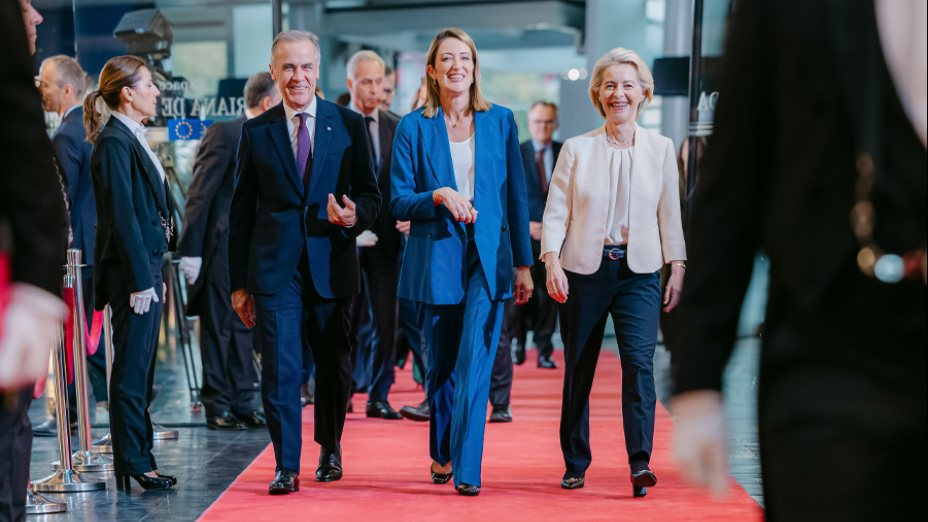
(c) European union, 2026
SOTEU26: reactions from the network
In an increasingly polarised parliament, MEPs and observers wonder each year how Ursula von der Leyen will maintain the balancing act – but this time she seems to have left all sides wanting more.
The Commission president took to the podium on Wednesday morning (16 September), in the presence of a special guest.
Gripes all round
Evelyn Kaldoja is Kuku Raadio’s Europe, NATO and diplomacy correspondent. She summarised the mood in Strasbourg just after the speech ended.
Evelyn Kaldoja, Europe Correspondent at Kuku Raadio (in Estonian):
“Her main approach to resolving various issues was essentially to hold a summit or to issue a framework. Bureaucratic promises that could mean anything or nothing. Having now heard the initial reactions to this speech from the various political groups in the European Parliament, most of them are dissatisfied – from the communists to the far right, everyone has something to say. And the complaints and grievances [...] do seem, in a way, to be justified: the climate is indeed in a bad state, and the borders are indeed in a bad state, and so on. The same applies to social issues.”
https://kuku.postimees.ee/podcast/sihik/313968
As ever, there seems to be quite a consensus on the bloc’s sluggishness in getting things done.
Sophie Wilmès, Renew Europe member and vice-president of the European Parliament, makes this point in relation to competitiveness initiatives. She is speaking to Belgium’s RTBF.
Sophie Wilmès, Vice-President of the European Parliament – Renew Europe, Belgium (in French):
“The real problem lies in the speed of action. We are expecting swift action, not just words. It is important to note that of the 400 initiatives announced, we know that around 100 of them have not even been tabled. Only 15 to 20 per cent of the [actions in the] Draghi report have been implemented. [...] Of course, democracy takes a bit of time. But between taking a bit of time and moving at a snail’s pace, I think there’s a middle ground to be had, and it’s vital we find it.”
Paweł Zerka is a senior policy analyst at the European Council on Foreign Relations. He spearheads the organisation's polling and research on foreign affairs and authors its European Sentiment Compass, an annual study that seeks to capture the prevailing mood in Europe.
This year's report looks at how anti-European forces are repackaging the past as a vision for the future, creating a kind of nostalgia. Speaking to our colleagues at The Europeans podcast just as VDL was wrapping up her speech, Zerka argued that pro-Europeans lack a similarly dynamic vision for people to rally around, and he links this back to a lack of concrete action in Brussels.
Paweł Zerka, Senior Policy Fellow at the European Council on Foreign Relations (in English):
“It's about policies not being seen by a large part of the public as being serious. So we have been talking about enlargement for so much time, but actually, who believes that, apart from Montenegro, any country will enter the European Union anytime soon? The single market, completion of the single market, is something which has been discussed for most of my life. In the latest State of the Union address, again, Ursula von der Leyen mentioned this, saying that within the next year, we will finally complete that project. To be seen. […] I think that there is a danger if you communicate policies that are not seen as seriously taken and implemented.”
In conversation with BNR, Radan Kanev, a Bulgarian MEP from von der Leyen’s own EPP group, also highlights a lack of tangible results from the vast swathes of European legislation adopted over the past year. That said, he points the finger firmly at national governments.
Radan Kanev, Member of the European Parliament – EPP, Bulgaria (in Bulgarian):
“Neither the European Commission nor the European Parliament has managed to convince national governments of the need for Europe to move forward with greater unity and speed. Much of the legislation aimed specifically at industrial policy and faster decision-making for businesses is being blocked at the national level. So is the push for a common defence – something we are very aware of in Bulgaria because, sadly, the Bulgarian government is one of those doing the blocking.”
Sophie Wilmès, despite hailing from a different political family, makes the very same point about national obstructiveness – but this time in relation to the integration of the single market.
Sophie Wilmès, Vice-President of the European Parliament – Renew Europe, Belgium (in French):
“We know just how much the barriers within Europe are costing Europe. It is also up to the member states to take further action. We need to be realistic. There is a lot of criticism of the European Commission, but I think the Council must also put its own house in order.”
Cost-of-living crisis
Lithuanian member Virginijus Sinkevičius, from the Greens/EFA group, commended the Commission chief for raising the day-to-day hardships faced by Europeans in her address – specifically the cost-of-living and housing crises.
Virginijus Sinkevičius, Member of the European Parliament – Greens/EFA, Lithuania (in Lithuanian):
“In her speech, the President emphasised that she sees not only geopolitical challenges, but also challenges within the EU itself – issues that Europeans face on a daily basis. And, whilst we in Lithuania are also talking about family policy, the challenge of housing affordability is even greater across Europe than it is here. Considerable attention was devoted to this topic. I am very pleased that the Commission is not just talking macroeconomics and geopolitics, but equally about the challenges faced by Europeans.”
Other voices within the European Parliament begged to differ, though, suggesting that not enough attention was devoted to this crucial topic. Portuguese socialist Marta Temido, for one.
Marta Temido, Member of the European Parliament – S&D, Portugal (in Portuguese):
“There is no concrete response to what is currently a major priority for many Portuguese people, and for many Europeans – namely the rising cost of living.”
Also talking to Renascença, Catarina Martins from The Left lists several issues on which she believes the Commission could be making a difference… but isn’t.
Catarina Martins, Member of the European Parliament – The Left, Portugal (in Portuguese):
“Where the European Commission could make a difference, for example on the cost of living, it doesn't. Where the EU could make a difference for peace, ending the association agreement with Israel, it doesn't. On the other hand, what the Commission president is proposing is a series of measures for which she has no formal legitimacy, which are not proposed in the treaties and which nobody understands.”
By which, of course, Martins is likely referring to the call to create a European Security Council, not to mention the much-publicised idea of Canada becoming an ‘associate member’ of the EU.
This latter topic has certainly caught everyone’s attention, given Mark Carney’s attendance at the address and his subsequent speech to the European Parliament on Thursday. But what does it mean to be an associate member, exactly? RTBF puts the question to Marianne Dony, a law professor at ULB in Brussels.
Marianne Dony, Professor of European Law at the ULB (in French):
“So far, nobody knows, because it is a concept that is completely unheard of in EU law. We are familiar with the status of ‘member’ or ‘associate’. But ‘associate member’ is a completely new concept.”
She points out that Canada could not become a full member of the EU – owing to its geography – but that neither would it wish to. And that if we really wanted to strengthen and deepen EU-Canada relations, the first step would be to ratify and bring into force the long-in-limbo CETA trade agreement.
Domy suggests, in fact, that the timing of this announcement is key – coming shortly after the acrimonious breakdown of trade talks between Canada and the US. A point that European Parliament vice-president Sophie Wilmès also raises in a separate discussion with RTBF.
Sophie Wilmès, Vice-President of the European Parliament – Renew Europe, Belgium (in French):
“I can’t say if this was a message on Ursula von der Leyen’s part, but it does raise some questions. At the very least, we need to consider the timing. After all, Mark Carney was invited straight after walking out of negotiations with Trump. I think we need to take this at face value.”
Interestingly, Canada’s next-door neighbour was not referenced even a single time in this year’s State of the EU address – conspicuous by its absence, you might say.
The D-word
As on other issues, such as the cost of living, opinions were also divided on whether VDL had placed too much or too little emphasis on defence and security. Kuku Raadio correspondent Evelyn Kaldoja thinks it’s the latter.
Evelyn Kaldoja, Europe Correspondent at Kuku Raadio (in Estonian):
“She spoke at great length about the economy, but said very little – and she only mentioned security, Ukraine, Russia and so on towards the end. She did convey the right messages, but somehow they were overshadowed.”
Meanwhile, The Left’s João Oliveira takes – perhaps predictably – a very different view, as he tells Renascença.
João Oliveira, Member of the European Parliament – The Left, Portugal (in Portuguese):
“Ms von der Leyen came to this debate wearing white; she might just as well have worn military fatigues. They would have suited her better. What really characterises the European Commission president’s speech is her advocacy of militarism, of a policy of confrontation and war, and of favouring the billion-dollar business that is amassing profits from the production of weapons and from death and destruction.”
Lithuania’s Virginijus Sinkevičius highlights the significance of his country being specifically mentioned in the speech in relation to threats to peace in Europe. Indeed, just the day before, a suspected Russian drone was shot down in Lithuania. Žinių Radijas reports.
Virginijus Sinkevičius, Member of the European Parliament – Greens-EFA, Lithuania (in Lithuanian):
“Lithuania was mentioned in the speech. And this is certainly an important point, demonstrating that the situation – the hybrid attacks Lithuania is facing, those provocations – are not isolated incidents, and nor are they seen merely as a challenge for Lithuania. They are seen as a challenge for the whole of Europe.”
Valdis Dombrovskis, the European Commissioner for the economy and productivity, places his focus on security in a chat with Latvijas Radio. This is perhaps not surprising given the fact that he is a former prime minister of another Baltic state: Latvia.
Valdis Dombrovskis, European Commissioner for Economy and Productivity (in Latvian):
“With regard to the establishment of a European Security Council, the drafting of specific protocols on how the EU should respond to threats to member states, and the creation of a new European instrument for developing the bloc’s defence capabilities – that is to say, in terms of specific equipment and such matters – these are all significant new announcements that are, first and foremost, of particular importance to the countries on the EU’s eastern border.”
Internal politics
In Ursula von der Leyen’s own words, “we should be under no illusions. The threats to our democracies do not only come from the outside. We see the rise of anti-democratic, anti-European forces.”
It goes without saying that Portuguese Patriots for Europe member Tiago Moreira de Sá had a lot to say about this statement.
Tiago Moreira de Sá, Member of the European Parliament – PfE, Portugal (in Portuguese):
“She does not take responsibility. There is always someone else to blame: external forces, then internal forces... As if this has only just come to light and she bears no responsibility for European governance over recent years; and as if she has borne no responsibility for the governance of a key member state – Germany – in the past. Just look at the state Germany is in.”
But, stresses ECFR policy analyst Paweł Zerka to The Europeans, the Commission president does not hold sole responsibility for the arguably sickening state of European democracy.
Paweł Zerka, Senior Policy Fellow at the European Council on Foreign Relations (in English):
“For me, the main problem are national leaders, heads of government, who, despite formally coming from pro-European parties and defining themselves as pro-European, have all too often – I mean, for example, Chancellor Merz or Prime Minister Donald Tusk – they have all too often been on the defensive in how Europe gets discussed in their national context. They have either winked at the far right when it comes to migration or climate in the hope of stopping the move of voters from the centre towards the extremes. But they have very rarely taken responsibility by explaining why certain European policies are important for their particular country. They have often failed to defend European policies and have rather used Brussels, the EU and the European Commission as a very useful scapegoat.”